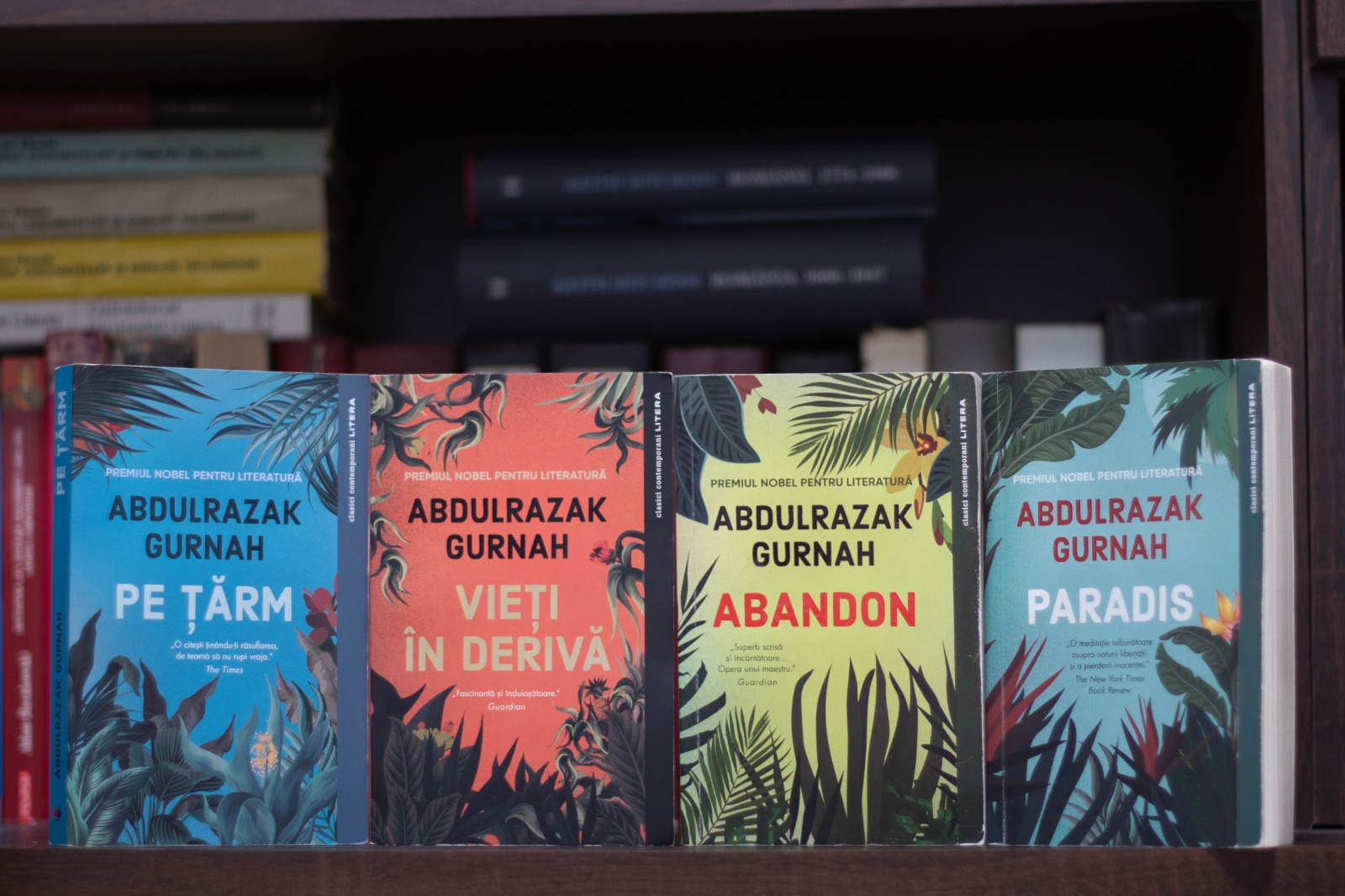
Through Abdulrazak Gurnah novels, I discovered an East Africa that rarely occupies the centre of the historical narratives I grew up studying. A world of Indian Ocean trade routes, Arab and African communities, European colonial ambitions, cultural encounters and deeply personal stories shaped by forces far beyond the control of ordinary people.
What fascinates me most about Gurnah is that he does not need extraordinary heroes to tell extraordinary stories. His characters are often vulnerable, displaced or caught between cultures, struggling to understand where they belong and how much control they have over their own lives.
After reading four of his novels, Paradise, By the Sea, Desertion and Afterlives, I began to recognise a common thread running through his writing: the idea that history does not simply happen around people, but it reshapes their relationships, separates families and sometimes follows them across continents.



Abdulrazak Gurnah: A Nobel Prize for the Stories between Continents
Abdulrazak Gurnah was born in 1948 in Zanzibar, an island in the Indian Ocean whose history reflects centuries of interaction between African, Arab, Persian, Indian and European cultures.
His own life was profoundly shaped by political upheaval. Following the Zanzibar Revolution of 1964 and the persecution of people of Arab origin, Gurnah left his homeland as a young man and arrived in Britain as a refugee in the late 1960s.
He later became a professor of English and postcolonial literature at the University of Kent, while developing a literary career centred on migration, memory, colonialism and the complicated experience of living between cultures.
In 2021, he received the Nobel Prize in Literature. The Swedish Academy recognised him for his compassionate and uncompromising exploration of colonialism’s consequences and the experiences of refugees caught between cultures and continents. I find this recognition particularly meaningful because Gurnah writes about histories that have often been overshadowed by European perspectives on Africa.
1. Paradise (1994): The Lost Innocence of East Africa
Paradise follows Yusuf, a young boy whose father effectively hands him over to a wealthy merchant to settle a debt. What begins as a childhood journey gradually becomes an encounter with the complicated social and economic realities of East Africa at the beginning of the twentieth century.
Through Yusuf’s experiences, Gurnah introduces us to a world shaped by trade, religious traditions, social hierarchies, exploitation and the growing presence of European colonial powers. What I found particularly interesting was the way the novel challenges the idea of an innocent African world suddenly corrupted by European arrival.
The society Yusuf encounters is already marked by inequality, dependence and forms of servitude. Colonialism does not enter an idealised paradise, but an existing world of power relations that it will profoundly transform. The title itself becomes increasingly ironic. What exactly is paradise? Is it the beauty of the landscape, the promise of freedom, the innocence of childhood or something that exists only in our imagination?
For me, Paradise is above all a novel about losing innocence. Yusuf gradually discovers that beauty and cruelty can coexist, and that the world is rarely as simple as it appears when we first encounter it. It also made me think about the historical complexity of the Swahili Coast, where African, Arab and Indian influences had interacted for centuries. Gurnah does not present this cultural diversity as a romantic ideal, but as a living world full of contradictions.
2. By the Sea (2001): Exile, Memory and the Meaning of Home
By the Sea approaches displacement from a different perspective. The novel begins with Saleh Omar, an older man from Zanzibar who arrives in Britain seeking asylum. Carrying very few possessions, including a small box of incense, he enters a world where his past is largely unknown and his future uncertain.
His story gradually becomes intertwined with that of Latif Mahmud, another man from Zanzibar living in England, whose memories reveal a complicated history of family conflicts, betrayal and loss. The past is not presented as something fixed or easily understood. Different people remember the same events differently, and the truth gradually emerges through conflicting perspectives. This makes By the Sea more than a novel about refugees.
I found the contrast between the two men particularly interesting. Both have left Zanzibar, yet exile has shaped them in different ways. Their relationships with memory, language and belonging reveal how personal the experience of displacement can be. The novel also raises a question that I find especially moving: what does home mean when returning is no longer possible, or when the place you remember no longer exists in the same form?
3.Desertion (2005): Love Across Cultures and Generations
If Paradise explores the loss of innocence and By the Sea examines the consequences of exile, Desertion explores what happens when love confronts the boundaries imposed by society, race, religion and history.
The novel begins in colonial East Africa with the encounter between Martin Pearce, an English traveller, and Rehana, a woman from the coastal community who helps care for him after he is found injured. Their relationship develops in a world where intimacy between people from different cultural and racial backgrounds challenges deeply established expectations.
But Gurnah does not limit the story to one relationship. He follows its consequences across generations, showing how decisions made in one historical period continue to influence lives decades later. Can two people truly escape the expectations of their communities? How much freedom do they have to choose one another? And what happens when the desire to love conflicts with the desire to belong somewhere?
I also found the title particularly powerful, Desertion can suggest the abandonment of a person, a family, a country or even a version of oneself. The novel made me reflect on how easily we romanticise relationships that cross cultural boundaries, forgetting that love does not automatically erase the social inequalities surrounding it.
4. Afterlives (2020): The Forgotten Lives of Colonial History
Of the four novels, Afterlives is perhaps the one that most directly confronts the violence of European colonialism in East Africa. Set against German colonial rule and the First World War, the novel follows characters whose lives are shaped by military recruitment, displacement, exploitation and the struggle to survive.
Among them are Hamza, who serves in the German colonial forces, and Ilyas, whose life becomes entangled with the colonial military system. Alongside them, other characters attempt to build ordinary lives in a world repeatedly disrupted by political and military violence.
When we study the First World War, we usually focus on European battlefields, political alliances and the collapse of empires. Yet the war also reached African territories, where local populations suffered enormously from military campaigns, forced labour, hunger and displacement. Afterlives shifts our attention towards those experiences, reminding us the consequences of colonial history.
Yet, there is tenderness in the relationships between its characters, in their attempts to care for one another and in their determination to create something resembling a normal life.
What I appreciate most about Gurnah is his refusal to simplify this world into a confrontation between colonisers and colonised. While exposing the devastating consequences of European imperialism, he also explores the inequalities, prejudices and power structures that existed within local societies, reminding us that history is rarely a story of clear divisions between good and evil. For someone who loves both history and travelling, his novels offer something particularly precious: the possibility of discovering a place through personal experiences, memories, cultural beliefs and touches of mysticism.