Han Kang is a South Korean writer, awarded with the 2024 Nobel Prize in Literature for her poetic prose that confronts historical trauma and reveals the fragility of human life. For me she is a poet of pain, an unique writer who examines suffering with an almost unsettling beauty. As her stories unfold, her characters often seem to descend further into despair. Yet the way she writes about them makes it impossible for me to turn away.
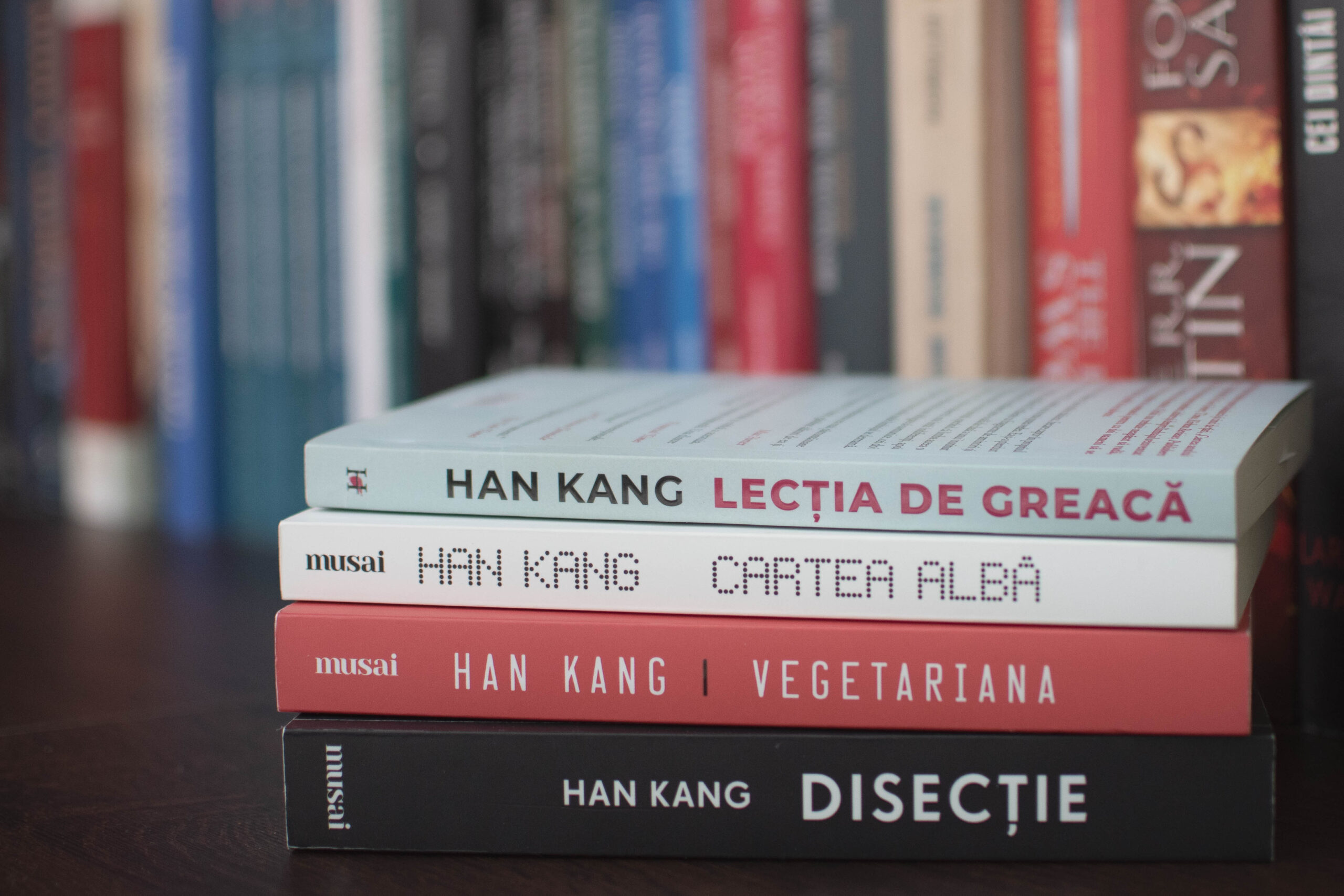
I have read four of her books: The Vegetarian, The White Book, Human Acts and Greek Lessons. Each is different in form and subject, yet they seem to speak to one another. Bodies become places of resistance or pain. Words fail, return, or offer a fragile way to connect. And in Human Acts, a city becomes inseparable from the people who lived through its history.
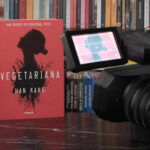
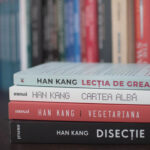
The Vegetarian: When a choice becomes a struggle
The Vegetarian was my introduction to Han Kang’s writing, and it unsettled me from the start. Yeong-hye’s decision to stop eating meat seems simple, but the reactions around her reveal how little freedom she has over her own body. Her husband and family speak about her, judge her and try to force her back into the life they expect her to lead.
What stayed with me was the tension between Yeong-hye’s silence and everyone else’s certainty that they know what is best for her. As the story grows stranger and darker, her refusal becomes about much more than food. It is a disturbing book, but one that made me think long after I finished it about control, vulnerability and the cost of being unable to live as yourself.
The White Book: A journey through grief
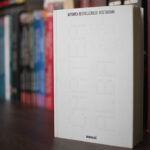
The White Book felt to me like a book written in a universal language of pain. Through a series of brief, delicate reflections on white objects, Han Kang writes about the sister who died shortly after birth, and about the life that became possible because of that loss.
There is no conventional story to follow. Instead, each image gives shape to something difficult to say: grief for someone she never knew, and the uneasy feeling of living in her place. Its quietness moved me most. Han Kang shows how a loss can remain present even when it happened before our own memories began.
Human Acts: Remembering Gwangju
Human Acts takes us to Gwangju and the aftermath of the violence against participants in the city’s 1980 uprising. Through connected voices, Han Kang shows how an event continues to shape survivors and families long after it has passed from the news. Human Acts is more than a novel; it is an ode to the young people of Gwangju, written with a terrifying depth of empathy. No other book has caused me such pain. The way Han Kang portrays the suffering and horror of May 1980 feels to me like something beyond art.
Greek Lessons: Finding a way back to language
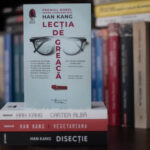
In Greek Lessons, a woman who has lost her ability to speak meets a teacher who is losing his sight. Their Greek lessons bring two isolated people into the same room, where connection begins through patience, attention and the effort to understand one another. After the force of The Vegetarian and Human Acts, this novel offers a gentler kind of intensity. It considers what happens when words are out of reach, and how much we can still communicate through presence and care.
These four books do not offer an easy journey through South Korea. They invite a slower kind of travel: one that notices the distance between people, listens to what history has left behind, and allows a place to be more than its visible landmarks. Han Kang reminds us that to understand where we are, we must also pay attention to the lives we cannot immediately see. Even when Han Kang writes about violence, trauma or unbearable loss, there is a quietness in her words, she gives pain a voice and a shape, and sometimes finds a strange beauty in it.