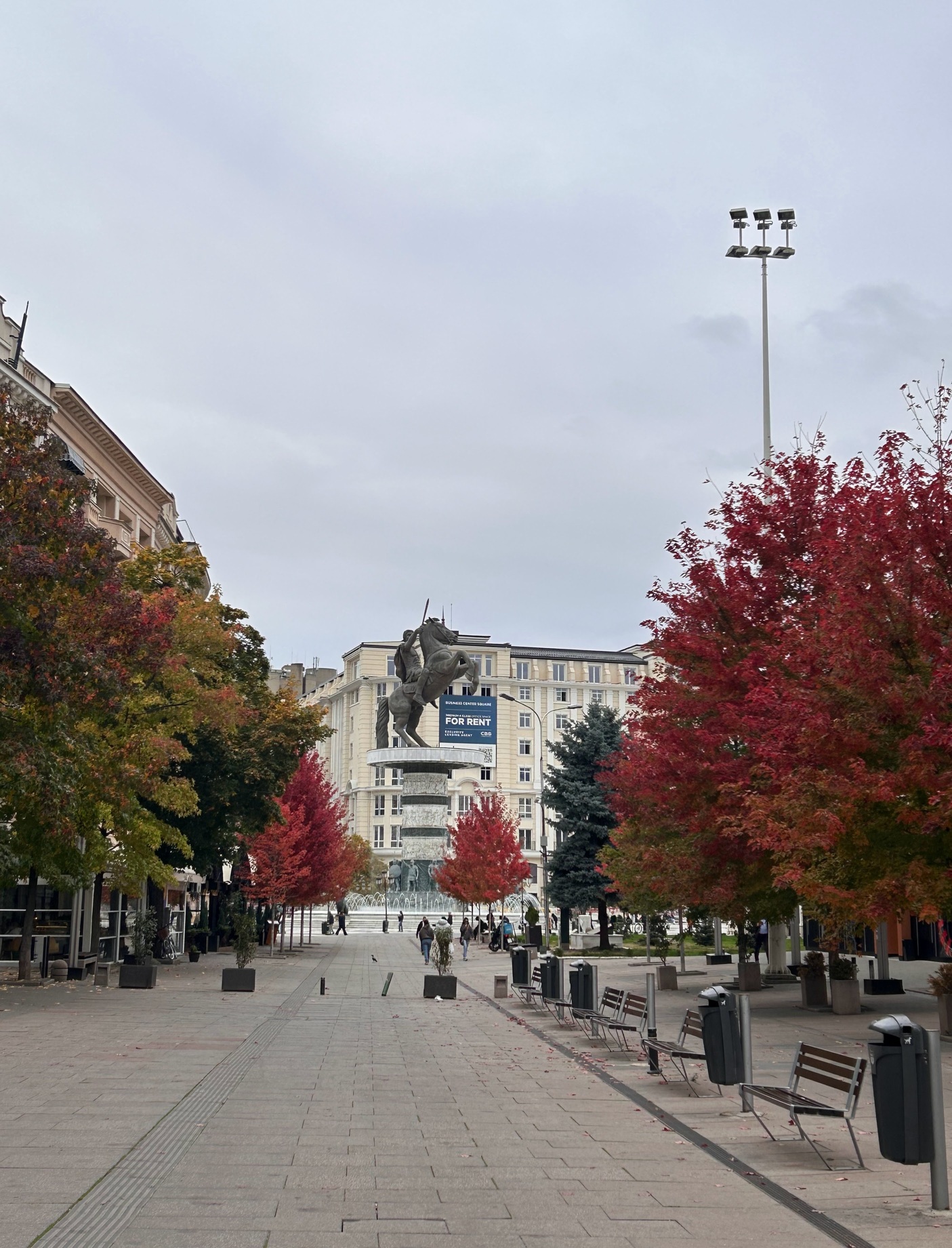
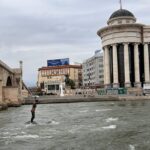
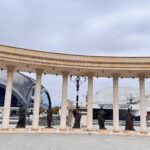
I have always been fascinated by cities where different cultures, historical periods and identities overlap. Skopje, the capital of North Macedonia, turned out to be one of the most unusual examples I have visited. Walking through its centre, I couldn’t help noticing the extraordinary number of statues. Warriors, kings, revolutionaries and historical figures seemed to appear at every corner, surrounded by monumental fountains and buildings that looked much older than they actually were. At times, the entire city centre felt like an enormous stage set, where history had been recreated with an almost excessive enthusiasm.
A City Rebuilt After Disaster
There is another important chapter in Skopje’s history that helps explain its unusual appearance. On 26 July 1963, a devastating earthquake destroyed much of the city, killing more than a thousand people and leaving tens of thousands homeless.
The disaster transformed Skopje into an international symbol of solidarity. Countries from both sides of the Cold War contributed to its reconstruction, while Japanese architect Kenzo Tange became one of the central figures in planning its modern urban future. The result was a city of bold modernist architecture, concrete structures and ambitious urban planning.
Some of those buildings still survive today, creating yet another architectural layer beneath the more recent neoclassical decorations. This makes Skopje’s transformation particularly fascinating. A city once rebuilt as a symbol of modernity later attempted to reinvent itself through an idealised vision of classical antiquity.
Mother Teresa and the Many Identities of Skopje
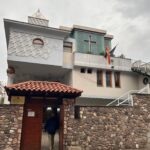
Among the warriors, emperors and political figures, another historical personality connects Skopje to the wider world: Mother Teresa. Born Anjezë Gonxhe Bojaxhiu in Skopje in 1910, she came from an ethnic Albanian Catholic family, at a time when the city was still part of the Ottoman Empire.
Today, the Mother Teresa Memorial House commemorates her life and legacy. Her story is also a reminder that North Macedonia cannot be understood through a single ethnic or historical narrative. The country is home to a significant ethnic Albanian population, alongside Macedonians and other communities, and relations between these groups have not always been peaceful. In 2001, an armed conflict between ethnic Albanian insurgents and state security forces brought the country close to a wider crisis.
The Ohrid Framework Agreement helped end the conflict and introduced reforms intended to improve the rights and representation of ethnic communities. This diversity is particularly visible in Skopje, where languages, religions, architectural traditions and historical memories coexist, sometimes comfortably and sometimes uneasily. It is a city that cannot easily be reduced to one identity, no matter how many statues are erected to represent it.
Skopje 2014: When a City decided to Reinvent itself
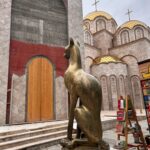
The first thing that strikes you in central Skopje is the sheer number of monuments. It is almost impossible to walk for a few minutes without encountering another historical figure immortalised in bronze.
At the heart of Macedonia Square stands the enormous Warrior on a Horse, widely understood to represent Alexander the Great, although officially given a more generic name. Surrounded by fountains, lions and elaborate decorations, the monument rises above the square with an almost theatrical confidence.
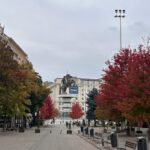
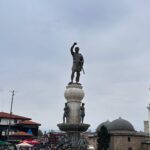
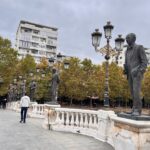
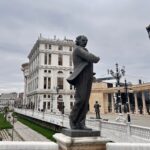
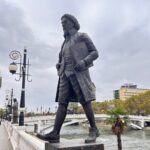
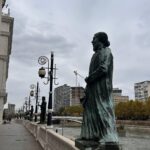
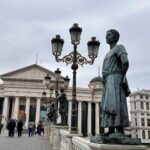
This is perhaps the most recognisable symbol of Skopje 2014, an ambitious urban redevelopment project launched by the government in 2010. Its aim was to give the capital a more monumental appearance and reinforce a particular vision of Macedonian national identity. New government buildings, museums, bridges and statues transformed the city centre. Modernist façades were concealed behind classical-looking architectural elements, while historical figures from different centuries appeared together in an extraordinary display of national symbolism.
There are moments when the statues seem to compete with one another for attention, and the attempt to create historical grandeur becomes so excessive that it is difficult not to smile, but what makes Skopje interesting is that the kitsch is not simply decorative. It is political because every statue, every reconstructed façade and every monumental gesture seems to participate in a larger conversation about history, belonging and national identity.
The City beneath the Statues
Across the Vardar River, the atmosphere changes dramatically. The Old Bazaar, with the Ottoman-era streets, mosques, traditional shops and small cafés, offers a completely different perspective on the city. Here, Skopje feels less concerned with monumental statements and more connected to everyday life.
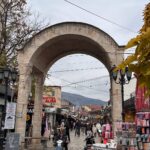
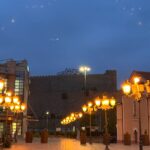
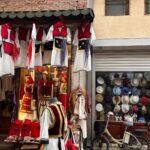
The Ottoman presence shaped the city for more than five centuries, leaving behind a rich architectural and cultural heritage. The Old Bazaar remains one of the most evocative places to experience that history, reflecting the coexistence and interaction of different religious and ethnic communities. The contrast between the enormous statues on one side of the river and the narrow streets of the bazaar on the other almost feels like a conversation between two different ways of remembering the past.
I left Skopje with mixed feelings, but certainly not indifferent. I was amused by the endless statues, intrigued by the contrast between the Old Bazaar and the monumental city centre, and fascinated by the layers of history hidden beneath the architectural spectacle.
Skopje may never win a competition for architectural harmony, but it has something that I value deeply when travelling: the ability to make me curious. It reminds me that cities are reflections of the societies that build them, destroy them, reconstruct them and continuously reinterpret their past.